In This Article
Why Lick Bowls for Dogs Deserve a Spot in Your Kitchen
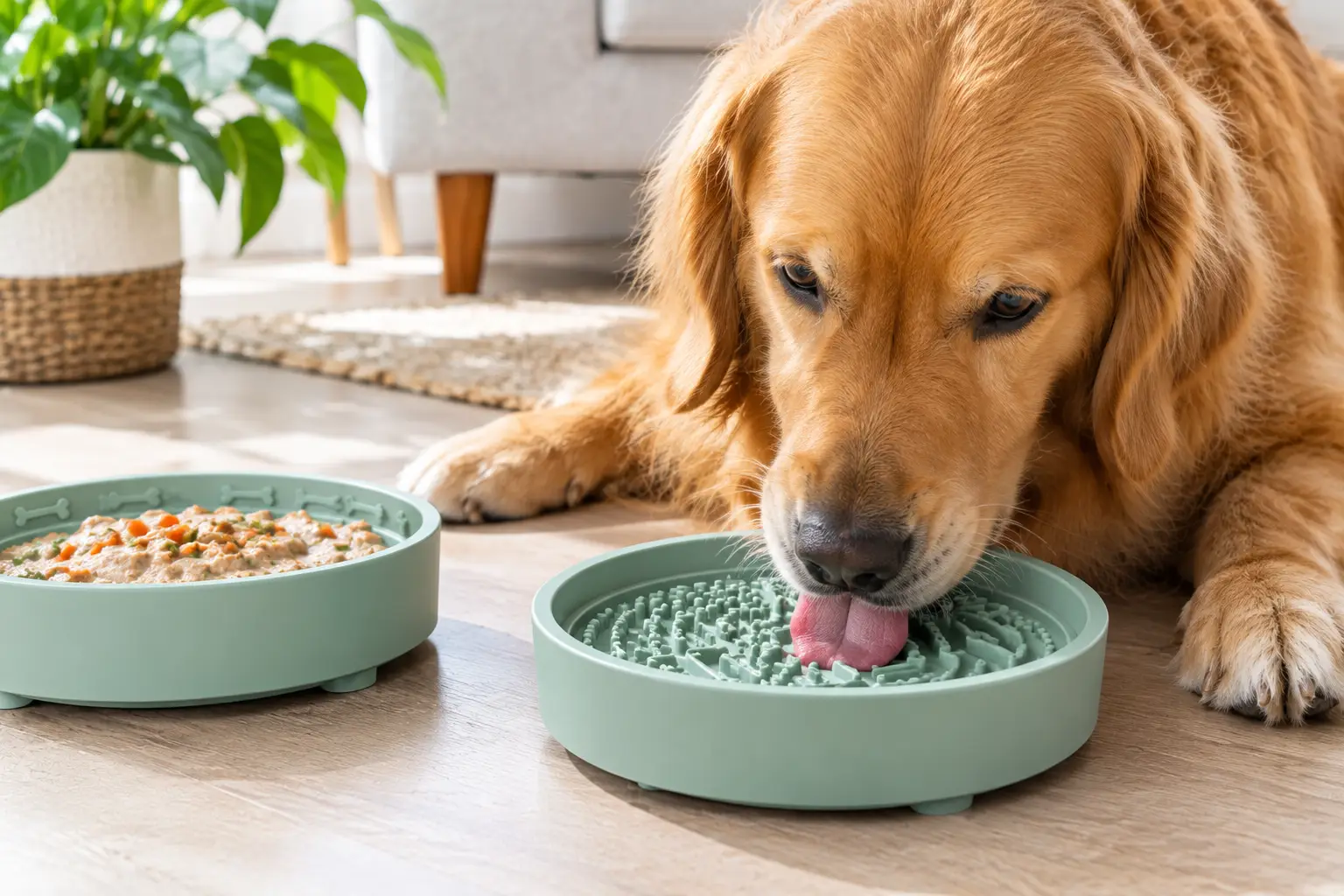
Picture this: the doorbell rings, the vacuum roars to life, or the Fourth of July fireworks start popping two streets over. Your dog paces, pants, and starts eyeing the couch cushion like it owes him money. Now picture the same scene, except your pup is lying flat on the kitchen floor, tongue working steadily through a frozen layer of yogurt and pumpkin. That’s the quiet magic that lick bowls for dogs are designed to deliver.
Lick bowls for dogs have moved from a niche trainer’s trick to a mainstream enrichment staple. Amazon search-tracking data from mid-2026 shows thousands of weekly US searches for “dog lick bowl” alone, and the category has exploded with everything from vet-designed rubber bowls to spinning puzzle feeders. That popularity is a blessing and a curse: there are more good options than ever, but also a flood of near-identical, anonymous listings that are hard to tell apart.
This guide cuts through that noise. Instead of rewording product listings, we compare real spec sheets, translate features into what they mean on your kitchen floor, and flag where the available customer feedback is solid versus thin. You’ll also get a 30-day getting-started plan, a problem-solving guide, a buyer’s decision framework, and a safety section on what should (and should never) go inside the bowl.
The American Kennel Club’s own guide to lick mats for dogs highlights benefits like easing separation anxiety, slowing down fast eaters, and offering simple entertainment, while also recommending supervision. A bowl-shaped design builds on those same benefits and adds depth, which means more food capacity, less smearing, and better handling of liquids like bone broth.
Whether you’re shopping for a nervous rescue, a kibble-inhaling Lab, or a senior dog who needs a gentle daily activity, one of the seven picks below should fit. Let’s dig in. 🐾
What Are Lick Bowls for Dogs?
Lick bowls for dogs are bowl-shaped enrichment feeders with textured interiors (ridges, dimples, honeycombs, or spinning tiers) that force a dog to lick food out slowly instead of gulping it. Typically made of food-grade silicone, natural rubber, or BPA-free plastic, they calm anxious dogs, slow fast eaters, and serve soft, frozen, or liquid treats.
How a dog licking bowl differs from a flat lick mat
A flat lick mat is basically a textured placemat. It works beautifully for a thin smear of peanut butter, but it can’t hold liquids, and many dogs quickly learn to drag it across the floor. A lick bowl adds walls and depth. That small change matters more than it sounds:
- ✅ More capacity: a bowl can hold a full meal of wet food or a cup of broth, not just a garnish.
- ✅ Better freezing: you can layer ingredients vertically, which stretches a session from minutes to much longer.
- ✅ Less mess: walls keep runny foods contained, especially on hardwood floors.
Who actually benefits
Lick bowls make the most sense for dogs that eat too fast, dogs that get stressed by storms, grooming, or being left alone, puppies in crate training, and older dogs who still crave a “job” but can’t handle a high-energy puzzle. They’re not a cure for clinical anxiety, but as one tool in a broader plan, they’re among the easiest wins in canine enrichment.
Quick Comparison: Lick Bowls for Dogs at a Glance
| Product | Style | Main Material | Stability | Best For |
|---|---|---|---|---|
| LickiMat Wobble | Wobbling lick bowl | Natural rubber | Intentionally wobbles | LickiMat Wobble: small/medium dogs who need extra challenge |
| Mighty Paw Dog Lick Bowl | 2-mode lick bowl | Food-grade silicone | Stable or wobbly | Mighty Paw Dog Lick Bowl: owners who want adjustable difficulty |
| Messy Mutts Therapeutic Lick Bowl Mat | Mat + center bowl hybrid | Food-grade silicone | Flat, non-slip | Messy Mutts Therapeutic Lick Bowl Mat: mixing liquids and spreads |
| Outward Hound Lickin’ Layers | Spinning 3-tier puzzle | BPA-free plastic | Wide, heavy base | Outward Hound Lickin’ Layers: food-motivated medium/large dogs |
| Outward Hound Lick N’ Flip | Beginner flip puzzle | BPA-free plastic | Non-slip base, no suction | Outward Hound Lick N’ Flip: puppies and puzzle beginners |
| Yipetor Slow Feeder Lick Bowl | Rolling-ball liquid bowl | Food-grade rubber | Anti-slip base | Yipetor Slow Feeder Lick Bowl: broth, yogurt, and supplements |
| SodaPup Honeycomb eBowl | Deep segmented bowl | Molded, flexible | Flat base | SodaPup Honeycomb eBowl: raw or mixed meals, US-made preference |
Looking at the table above, the split is really between “challenge” designs (LickiMat Wobble, Outward Hound Lickin’ Layers, SodaPup Honeycomb eBowl) and “comfort” designs that prioritize easy access and mess control (Messy Mutts Therapeutic Lick Bowl Mat, Yipetor Slow Feeder Lick Bowl). The Mighty Paw Dog Lick Bowl sits in the middle thanks to its switchable modes, which is why it’s the safest first purchase if you’re not sure how your dog will react.
💬 One click helps other shoppers make an informed choice too! 😊
Top 7 Lick Bowls for Dogs: Expert Analysis
1. LickiMat Wobble — the original wobble challenge in natural rubber
The LickiMat Wobble takes the classic LickiMat dimpled surface and wraps it inside a rounded bowl that rocks as your dog licks. That motion is the whole point: every lick shifts the target slightly, so your dog has to stay engaged rather than zoning out.
Retail listings put it at roughly 15 x 15 x 8 cm (about 6 x 6 x 3 inches), which tells you it’s sized for small and medium dogs, not a Great Dane. It’s made from natural rubber rather than silicone, so it has a grippy, slightly heavier feel, and it’s listed as freezer-friendly and safe in the lower rack of the dishwasher. In practice, the dimples hold spreads well and lock frozen layers in place, which stretches sessions considerably.
Based on comparing the specs, this is the pick for a confident small-to-medium dog who finds flat mats too easy. It’s less ideal for heavy chewers: LickiMat explicitly says it is not a chew toy and points chewers toward its tougher “Tuff” line instead. Vetstreet’s lick-mat roundup named the LickiMat Wobble its top choice for enrichment, noting it demands more effort than a typical flat mat.
Pros:
- ✅ Wobble motion adds genuine mental challenge
- ✅ Natural rubber, no silicone, recyclable per the brand
- ✅ Freezer- and dishwasher-friendly for easy prep
Cons:
- ❌ Too small for most large breeds
- ❌ Not suitable for dogs who chew enrichment toys
Expect it in the $15-$25 range (check the current price); for small and medium dogs, that’s solid value for a durable, purpose-built design.
2. Mighty Paw Dog Lick Bowl — switch between stable and wobbly modes
The Mighty Paw Dog Lick Bowl solves a common beginner problem: you don’t know whether your dog will love a wobbling bowl or find it frustrating. Here, you get both.
According to the brand’s specs, it’s made from BPA-free, food-grade silicone, measures 6.75 inches across and 3.25 inches tall, and offers two modes (stable and wobbly) plus four interior textures labeled for different purposes. In practice, the four textures let you “zone” the bowl: put the easy-to-reach treat in the shallow texture and a stickier one in the tighter grooves, so the session gets harder as it goes. The silicone is dishwasher-safe, which is a big deal if you’re using it daily.
Here’s what to weigh: silicone is flexible and gentle on teeth, but it’s also more tempting to gnaw than firm rubber or plastic. That makes this ideal for lickers rather than chewers. It’s a strong first bowl for an anxious dog because you can start in stable mode and graduate to wobbly once your dog understands the game.
Honestly, much of the visible review data on retailer pages is marked as incentivized, so treat the glowing star ratings with some caution. For Mighty Paw’s companion lick pad, one reviewer noted that clever dogs can pop suction cups loose, a useful reminder to supervise.
Pros:
- ✅ Two difficulty modes in one bowl
- ✅ Four textures for layered, progressive sessions
- ✅ Dishwasher-safe, food-grade silicone
Cons:
- ❌ Soft silicone tempts determined chewers
- ❌ Independent review data is limited
Usually in the $12-$18 range; a smart value since it effectively replaces two separate bowls.
3. Messy Mutts Therapeutic Lick Bowl Mat — the mat-and-bowl hybrid for mixed menus
The Messy Mutts Therapeutic Lick Bowl Mat is the most versatile “kitchen tool” on this list, combining a full grooved lick mat with a recessed bowl in the center.
The 10 x 10-inch mat is made of food-grade silicone that is BPA- and PVC-free, plus odor- and stain-resistant. The center well holds up to about 1 cup (250 ml) of liquid, and listings describe it as freezer-, microwave-, oven-, and dishwasher-safe. Some listings bundle it with an 11-inch silicone spatula meant to keep pet-food prep separate from your own utensils. In real terms, that oven-safe rating means you can actually bake a thin treat layer right on it, then freeze broth in the center for a two-stage session.
On paper, this is the best pick for owners who rotate ingredients, such as a smear of pumpkin on the grooves and bone broth in the middle. The flat, wide format is also more stable for big dogs than a small rounded bowl. The trade-off: a flexible flat mat is easier for a pushy dog to fold, pick up, or carry off.
We couldn’t verify a large pool of independent US customer reviews for this specific bowl-mat version, so we’re relying on the published specs here rather than aggregated sentiment.
Pros:
- ✅ Holds both spreads and up to a cup of liquid
- ✅ Oven, microwave, freezer, and dishwasher safe
- ✅ Odor- and stain-resistant silicone
Cons:
- ❌ Flexible mat can be folded or carried off
- ❌ Large footprint takes freezer space
Typically $15-$22 (prices may vary); excellent value if you want one tool for treats, meals, and broth.
4. Outward Hound Lickin’ Layers — three spinning tiers for brainy, food-driven dogs
The Outward Hound Lickin’ Layers is a lick bowl, slow feeder, and puzzle in one, designed by enrichment pioneer Nina Ottosson.
It’s rated Level 2 on Outward Hound’s difficulty scale, with three spinning layers and over 100 textured compartments. Your dog has to lick, nudge, and paw each tier around to uncover food. It holds roughly 2 cups, so it can handle a full kibble meal for many medium dogs. It’s made without BPA, PVC, or phthalates. In practice, the spinning tiers add a problem-solving layer that a plain lick bowl can’t match, which matters for clever breeds like Border Collies and poodle mixes who solve simple mats in minutes.
Who it’s for: medium and large, food-motivated dogs who need more than licking to stay occupied. Who it’s not for: timid dogs who may give up if food isn’t immediately accessible. Start with only the top layer filled.
Chewy customer reviews commonly report that food-motivated dogs figure it out quickly and that it does slow down kibble eating; owners also appreciate that it holds a 2-cup meal. Per Chewy’s Q&A, it fits inside a stainless steel bowl wider than about 10.35 inches if you want extra stability.
Pros:
- ✅ Combines licking, puzzle-solving, and slow feeding
- ✅ Holds a full 2-cup kibble meal
- ✅ Over 100 compartments for varied challenge
Cons:
- ❌ Too hard at first for some anxious dogs
- ❌ More parts to clean than a single bowl
Usually $18-$28 (check current pricing); excellent value for the amount of enrichment packed in.
5. Outward Hound Lick N’ Flip — the easiest on-ramp for puppies
The Outward Hound Lick N’ Flip is the Level 1 sibling to Lickin’ Layers, built specifically for puppies and dogs new to enrichment.
It’s a 3-in-1 lick mat, slow feeder, and simple puzzle with textured grooves. Difficulty is adjustable: fill only the top layer for an easy win, or use the bottom layer and freeze smears for a longer challenge. The base is non-slip but has no suction cups, and the brand suggests placing it on a rug or towel if it slides. For cleaning, you flip it over and squeeze a post to release the layers, then hand wash or use the top rack of the dishwasher. It’s BPA-, PVC-, and phthalate-free.
Based on the design, this is the bowl to buy before you buy a harder one. Puppies learn the “lick and work for it” concept without getting frustrated, which builds the confidence they’ll need for tougher puzzles later. It’s also a compact option for crate time and travel.
The product is relatively new, so we couldn’t verify a meaningful volume of aggregated customer reviews. The good news: its design logic matches the well-reviewed Lickin’ Layers, just simplified.
Pros:
- ✅ Truly beginner-friendly Level 1 difficulty
- ✅ Adjustable challenge as your dog improves
- ✅ Disassembles easily for thorough cleaning
Cons:
- ❌ No suction cups; may slide on smooth floors
- ❌ Limited review history so far
Often around $10-$15; outstanding value as a starter enrichment tool.
6. Yipetor Slow Feeder Lick Bowl — built for broth, yogurt, and liquid supplements
The Yipetor Slow Feeder Lick Bowl is designed around a problem most lick mats ignore: liquids. A floating ball sits inside the bowl and rolls as your dog licks.
The listing describes a 3/4-cup capacity, a food-grade rubber body, a natural rubber outer lid that keeps the ball contained, an anti-slip base, and dishwasher-safe construction. In practice, your dog can only reach a little liquid at a time around the moving ball, so a cup of broth becomes a slow, absorbing session instead of a three-second slurp. That also makes it handy for post-surgery recovery or seniors who need nutrition in liquid form, as the listing suggests.
What the spec sheet says clearly, and you should take seriously: supervise closely, because some dogs may work the ball out, creating an ingestion risk. This bowl is for supervised sessions, not for leaving with a dog in a crate.
Reviews consistently report long engagement. A SheKnows roundup of Amazon shopper feedback cites owners saying it kept a German Shepherd busy for around an hour per cup, and one owner of a chronically anxious dog credited it with reducing self-soothing paw licking.
Pros:
- ✅ Handles broth and runny foods without splashing
- ✅ Long engagement time reported by many owners
- ✅ Dishwasher-safe for daily use
Cons:
- ❌ Ball removal is a supervision must
- ❌ Smaller 3/4-cup capacity for big dogs
Typically in the $10-$20 range; great value if liquid treats are your main use.
7. SodaPup Honeycomb eBowl — American-made, deep-segment challenge
The SodaPup Honeycomb eBowl is a slow-feeder bowl with a strong lick-bowl personality, made by the Boulder, Colorado–based SodaPup.
The company describes its products as American-made molded goods, and this bowl uses a deep honeycomb pattern of segments with varying depths and opening sizes. It’s dishwasher- and freezer-safe. In practice, the deep cells mean dogs must push their tongues into each segment, which naturally slows eating and creates licking behavior even with chunky foods. SodaPup also notes you can separate wet and dry foods in different chambers, and its Great Outdoors version is pitched as deep enough for raw meals (with vet guidance). It’s offered in several designs, including Honeycomb, Great Outdoors, and Java.
Based on comparing the specs, this is the pick for owners who feed wet, raw, or mixed meals and want the main daily bowl itself to be the enrichment, rather than a side treat. US manufacturing will also matter to some buyers. Like most bowls here, SodaPup warns it’s not a chew toy and should be supervised.
We couldn’t verify a large body of independent aggregated reviews; the brand’s own product page shows owner comments, but the sample is small.
Pros:
- ✅ Deep segments slow even enthusiastic eaters
- ✅ Made in the USA by an enrichment specialist
- ✅ Separates wet and dry foods neatly
Cons:
- ❌ Pricier than generic lick bowls
- ❌ Deep cells take more effort to scrub
Usually $20-$35 (prices may vary); worth it if this becomes your dog’s everyday meal bowl.
Lick Bowls for Dogs Compared Side by Side
| Product | Capacity / Size | Dishwasher Safe | Price Range | Review Data We Could Verify | Best For |
|---|---|---|---|---|---|
| LickiMat Wobble | ~6 x 6 x 3 in | Yes (lower rack) | $15-$25 | Editorial pick (Vetstreet) | LickiMat Wobble: challenge for small/medium dogs |
| Mighty Paw Dog Lick Bowl | 6.75 in wide, 3.25 in tall | Yes | $12-$18 | Mostly incentivized reviews | Mighty Paw Dog Lick Bowl: first-time buyers |
| Messy Mutts Therapeutic Lick Bowl Mat | 10 x 10 in, 1-cup well | Yes | $15-$22 | Limited | Messy Mutts Therapeutic Lick Bowl Mat: mixed treats + liquids |
| Outward Hound Lickin’ Layers | ~2 cups | Check listing | $18-$28 | Chewy owner reviews | Outward Hound Lickin’ Layers: full kibble meals |
| Outward Hound Lick N’ Flip | Small | Yes (top rack) | $10-$15 | Limited (newer) | Outward Hound Lick N’ Flip: puppies |
| Yipetor Slow Feeder Lick Bowl | 3/4 cup | Yes | $10-$20 | Shopper reviews (SheKnows roundup) | Yipetor Slow Feeder Lick Bowl: broth and supplements |
| SodaPup Honeycomb eBowl | Full meal bowl | Yes | $20-$35 | Limited | SodaPup Honeycomb eBowl: wet/raw daily meals |
This table makes one thing clear: there’s no single winner, because these bowls answer different questions. If your priority is liquids, the Yipetor Slow Feeder Lick Bowl and Messy Mutts Therapeutic Lick Bowl Mat lead; if it’s replacing a full meal bowl, the Outward Hound Lickin’ Layers and SodaPup Honeycomb eBowl pull ahead. Notice too how thin verified review data is for several products, which is exactly why spec-based reasoning matters in this category.
How to Get Started: Your First 30 Days With a Dog Lick Bowl
A lick bowl only works if your dog likes it, and first impressions count. Here’s a simple ramp-up plan.
Week 1: Make it ridiculously easy
Use a high-value, spreadable food your dog already loves, such as plain canned pumpkin or their usual wet food. Spread a thin layer, skip the freezer, and set the bowl in stable mode if it has one (the Mighty Paw Dog Lick Bowl, for example). Sit nearby. Aim for short, 5- to 10-minute sessions so your dog finishes with a “win.”
Week 2: Add texture and time
Press food deeper into the grooves or dimples, and try a 30- to 60-minute chill in the fridge so the surface firms up. If your bowl wobbles or spins, now is the time to switch it on, or fill a second tier of the Outward Hound Lick N’ Flip.
Week 3: Introduce freezing and layering
Freeze a base layer of broth or watered-down yogurt, add a middle layer of wet food, and top it with a smear of pumpkin. Frozen layers can turn a five-minute snack into a much longer session. Check that the bowl is labeled freezer-safe first.
Week 4: Build routines
Attach the bowl to specific triggers: bath time, nail trims, the moment you leave for work, or thunderstorms. Over time, your dog links those stressful events to something pleasant.
Common mistakes in the first 30 days:
- ❌ Starting with the hardest puzzle setting and frustrating your dog
- ❌ Leaving the bowl unsupervised before you know your dog won’t chew it
- ❌ Forgetting to count lick-bowl calories toward daily food intake
Real-World Scenarios: Matching the Right Lick Bowl to Your Dog
Specs only mean something in context. Here are three common households and the bowls that fit them best.
Scenario 1: The apartment-dwelling anxious rescue
Maya lives in a city apartment with a 35-pound rescue who panics when left alone and during garbage-truck mornings. She has a modest budget of about $20 and plans to use the bowl daily. The Mighty Paw Dog Lick Bowl fits best: she can start in stable mode for confidence, switch to wobbly mode later, and toss it in the dishwasher every night. Because her dog isn’t a chewer, soft silicone is fine.
Scenario 2: The suburban family with a speed-eating Lab
The Garcias have a 75-pound Labrador who inhales two cups of kibble in under a minute, plus two kids who’d love to “help” with dog chores. They’re willing to spend $25 to $35. The Outward Hound Lickin’ Layers suits them: it holds a full meal, turns dinner into a puzzle, and gives the kids an easy job of loading the tiers. Many owners place it inside a wide stainless bowl for extra stability.
Scenario 3: The senior dog recovering from surgery
Robert’s 12-year-old Beagle mix just had dental work and needs soft, liquid-heavy food for a couple of weeks. He wants something gentle and calming. The Yipetor Slow Feeder Lick Bowl makes sense here because it’s built for broth and supplements, while the Messy Mutts Therapeutic Lick Bowl Mat is a strong runner-up if he wants to combine a soft spread with liquid. Supervision is non-negotiable with the Yipetor’s rolling ball.
✨ Don’t miss these top-rated enrichment picks!
🔍 Ready to turn your dog’s mealtime into a calming, brain-boosting ritual? Click any highlighted bowl in this guide to check current pricing and availability. The right lick bowl can bring more peace and quiet to your whole household! 🐶
Problem → Solution: Fixing the Most Common Lick Bowl Headaches
Even the best design can run into hiccups. Here’s how to fix the most frequent ones.
Problem 1: “My dog ignores the bowl.”
Solution: The challenge is probably too high, or the food isn’t exciting enough. Go back to an unfrozen, thin layer of a high-value food, and try a beginner design like the Outward Hound Lick N’ Flip with only the top layer filled.
Problem 2: “My dog chews the bowl instead of licking it.”
Solution: Stop unsupervised use immediately. Firmer materials, like the natural rubber of the LickiMat Wobble or hard plastic puzzles, are less tempting than soft silicone, but no bowl on this list is designed as a chew toy. Offer an appropriate chew toy separately to meet that need.
Problem 3: “The bowl slides all over the floor.”
Solution: Place it on a rubber bath mat, a towel, or carpet. For the Outward Hound Lickin’ Layers, nest it inside a large stainless bowl. Flat designs like the Messy Mutts Therapeutic Lick Bowl Mat also tend to stay put better than rounded ones.
Problem 4: “Cleaning is a nightmare.”
Solution: Rinse right after use, before food dries. Choose dishwasher-safe models, and use a small bottle brush on deep cells like those in the SodaPup Honeycomb eBowl. Soaking in warm, soapy water for 10 minutes loosens dried peanut butter.
Problem 5: “My dog finishes in two minutes.”
Solution: Freeze it in layers, use thicker foods, and switch on wobble mode. Rotating between two bowls also keeps novelty high.
How to Choose Lick Bowls for Dogs
Choosing well comes down to matching the bowl to your dog’s size, habits, and the food you’ll serve. Follow these steps:
- Measure your dog’s muzzle and size. A small bowl frustrates a big dog whose tongue can’t reach the bottom, while an oversized one overwhelms a toy breed.
- Identify chewers honestly. If your dog destroys toys, avoid soft silicone and supervise every session, whatever you buy.
- Decide what you’ll serve. Liquids need walls or a well; spreads work on dimples; kibble needs compartments or a puzzle.
- Pick a difficulty level. Beginners and anxious dogs need easy wins first; clever breeds need wobble, spin, or depth.
- Check the material. Look for food-grade silicone, natural rubber, or BPA-, PVC-, and phthalate-free plastic.
- Confirm cleaning options. Dishwasher-safe matters when you use the bowl daily.
- Think about health goals. For fast eaters, slower eating is one of several sensible precautions, especially for large, deep-chested breeds prone to gastric dilatation-volvulus (bloat), though a bowl alone is no guarantee of prevention.
Taken together, these steps usually narrow the field to one or two bowls within minutes.
Lick Bowl vs Lick Mat vs Slow Feeder Bowl
All three tools slow your dog down, but they do it differently, and that difference shapes how you’ll use them.
| Feature | Lick Bowl | Flat Lick Mat | Traditional Slow Feeder | Regular Bowl |
|---|---|---|---|---|
| Holds liquids | ✅ Yes | ❌ Rarely | ⚠️ Partly | ✅ Yes |
| Calming licking action | ✅ Strong | ✅ Strong | ⚠️ Moderate | ❌ None |
| Full meal capacity | ⚠️ Varies by model | ❌ Usually no | ✅ Yes | ✅ Yes |
| Freezing layers | ✅ Excellent | ⚠️ Thin layers only | ⚠️ Limited | ❌ No |
| Best For | Yipetor Slow Feeder Lick Bowl / LickiMat Wobble: calming plus liquids | Bath time, quick treats | Dry kibble meals | Water only |
The takeaway: a flat mat excels at quick distraction, like keeping a dog still in the tub, while a classic maze slow feeder is built for dry kibble. Lick bowls bridge those worlds, combining the calming effect of licking with real capacity and liquid handling. Hybrids like the Outward Hound Lickin’ Layers and SodaPup Honeycomb eBowl blur the line further by doubling as everyday meal bowls.
When a regular bowl still wins
Water should always be available in a plain, easy-access bowl. Enrichment bowls are for food and treats, never as your dog’s only hydration source.
Lick Bowls for Anxious Dogs: What Licking Can (and Can’t) Do
Repetitive licking is a natural self-soothing behavior for dogs, which is why trainers lean on lick bowls during storms, fireworks, vet visits, and grooming. Manufacturers often claim licking releases “feel-good” hormones; the honest framing is that licking is widely observed to calm dogs, and it gives an anxious dog a positive, absorbing task in place of pacing or barking.
Where a lick bowl helps
- ✅ Predictable stressors: storms, fireworks, nail trims, and baths. Freeze a bowl ahead of time so it lasts through the worst of it.
- ✅ Mild separation stress: a lick bowl given as you leave can shift your departure from “scary” to “snack time.”
- ✅ Crate training: pairing the crate with a supervised lick session builds positive associations.
Where it doesn’t
A lick bowl is not a treatment for severe separation anxiety, noise phobia, or compulsive behaviors. If your dog injures themselves, destroys doors, or panics for hours, talk to your veterinarian or a certified behavior professional. The bowl then becomes one helpful tool in a structured plan rather than the whole plan.
Picking a bowl for anxiety
For anxious dogs, easy access matters more than challenge. Start with the stable mode of the Mighty Paw Dog Lick Bowl or the spacious Messy Mutts Therapeutic Lick Bowl Mat. Save the spinning Outward Hound Lickin’ Layers for calmer moments, because a frustrating puzzle can add stress instead of relieving it.
Features That Actually Matter (and Ones That Don’t)
Product listings in this category are packed with buzzwords. Here’s how to separate signal from noise.
Features that matter
- ⚡ Material quality: food-grade silicone, natural rubber, or BPA-, PVC-, and phthalate-free plastic. This is your first filter.
- ⚡ Dishwasher compatibility: a bowl you can’t clean easily is a bowl you’ll stop using, and residue invites bacteria.
- ⚡ Correct size: the tongue-to-bowl fit determines whether your dog engages or gives up.
- ⚡ Adjustable difficulty: modes, tiers, or layers extend the bowl’s useful life as your dog gets smarter.
- ⚡ Stability strategy: a heavy base, suction, or deliberate wobble. Know which one you’re buying.
Features that matter less than marketing suggests
- ❌ Suction cups on bowls: helpful on tile, but determined dogs often pop them loose. Treat them as a bonus.
- ❌ “Oxygenates water” claims: some rolling-ball listings say the ball keeps liquids fresh. The useful benefit is slower intake and less splashing, not water chemistry.
- ❌ Dental miracle claims: textured surfaces may help scrape the tongue, but no lick bowl replaces brushing or veterinary dental care.
- ❌ Color and pattern: great for your Instagram, irrelevant to your dog.
The smartest buyers focus on the first list and treat the second as nice-to-have extras.
Long-Term Cost and Maintenance
Lick bowls are cheap upfront, but the real cost depends on durability and how often you’ll replace them.
| Product | Upfront Price Range | Likely Lifespan (supervised, non-chewer) | Maintenance Effort | Best Value For |
|---|---|---|---|---|
| Outward Hound Lick N’ Flip | $10-$15 | Long if not chewed | Low–medium | Outward Hound Lick N’ Flip: puppies on a budget |
| Mighty Paw Dog Lick Bowl | $12-$18 | Long if not chewed | Low | Mighty Paw Dog Lick Bowl: daily use |
| LickiMat Wobble | $15-$25 | Long; rubber resists wear | Low–medium | LickiMat Wobble: frequent freezing |
| SodaPup Honeycomb eBowl | $20-$35 | Long as a daily meal bowl | Medium (deep cells) | SodaPup Honeycomb eBowl: replacing the main bowl |
These lifespans are our estimates based on materials and design, not measured test data, and a single determined chew session can end any bowl’s life. The pattern is still useful: the cheapest bowl isn’t automatically the best value if you’ll replace it twice, while a premium meal-bowl replacement like the SodaPup Honeycomb eBowl earns its price through daily use.
Hidden costs to budget for
- 🔋 Fillings: plain pumpkin, low-sodium broth, and plain yogurt add up. Using your dog’s regular wet food keeps costs flat.
- 🔋 A second bowl: owning two lets you keep one in the freezer while the other is in use.
- 🔋 Calories: treats served in lick bowls still count, so reduce meal portions accordingly.
Simple maintenance schedule
Rinse after every use, run through the dishwasher daily if the bowl is rated for it, and inspect weekly for tears, cracks, or loose parts. Retire any bowl with damage your dog could bite off.
Safety, Materials, and What Goes Inside the Bowl
The bowl’s material is only half the safety story; the other half is what you put in it.
The xylitol warning every owner needs
Peanut butter is the classic filling, but some nut butters contain xylitol, a sweetener that’s toxic to dogs. The FDA’s consumer update, Paws Off Xylitol; It’s Dangerous for Dogs, explains that xylitol can trigger a rapid insulin release in dogs, leading to dangerously low blood sugar, with signs like vomiting, weakness, staggering, and seizures. Always read the label, and choose plain, unsweetened, xylitol-free products.
Other foods to keep out
Grapes, raisins, chocolate, onions, garlic, and heavily salted or fatty foods don’t belong in a lick bowl. If you think your dog has eaten something toxic, contact your veterinarian or the ASPCA Animal Poison Control Center right away.
Safe, popular fillings
- ✅ Plain canned pumpkin (not pie filling)
- ✅ Plain, unsweetened yogurt in small amounts
- ✅ Low-sodium, onion-free bone broth
- ✅ Your dog’s regular wet food
Material and supervision basics
Look for food-grade silicone, natural rubber, or plastics labeled BPA-, PVC-, and phthalate-free. Nearly every brand in this guide, from LickiMat to SodaPup to Yipetor, recommends supervision, and that advice is worth following, especially in the first few weeks and with any design that has removable parts.
Common Mistakes to Avoid When Buying a Dog Licking Bowl
Even savvy shoppers trip over these pitfalls.
Buying the cheapest anonymous listing
Search results are crowded with no-name lick bowls, and some carry very low ratings on major retail sites. With unclear materials and little accountability, a few extra dollars for an established brand is cheap insurance.
Ignoring size
A tiny bowl frustrates a large dog, and a giant mat is overkill for a Chihuahua. Compare listed dimensions against your dog’s muzzle before you buy.
Assuming “durable” means “chew-proof”
None of the seven bowls here are chew toys. If your dog chews everything, supervise every session and remove the bowl the moment chewing starts.
Choosing challenge over confidence
It’s tempting to buy the most complex puzzle, but an anxious or inexperienced dog may quit. Start easy, like the Outward Hound Lick N’ Flip, and level up.
Overlooking cleaning
Bowls with deep cells or many parts require more effort. If you know you won’t hand-scrub, stick with dishwasher-safe designs like the Mighty Paw Dog Lick Bowl.
Trusting star ratings blindly
Some reviews on retailer sites are incentivized or collected through promotions. Read the written comments, look for repeated complaints, and weigh specs as heavily as stars.
Lick Bowls for Dogs FAQs
❓ Are lick bowls for dogs worth buying for large breeds?
❓ Can I put dry kibble in a dog lick bowl?
❓ Which lick bowl is best for a puppy?
❓ How long should a lick bowl session last?
❓ Is a silicone or rubber lick bowl better for my dog?
Conclusion: Finding the Right Lick Bowl for Your Dog
The best lick bowls for dogs aren’t the flashiest ones; they’re the ones matched to your dog’s size, temperament, and menu. For most first-time buyers, the Mighty Paw Dog Lick Bowl is the easiest recommendation because its two modes let you find your dog’s sweet spot. Small and medium dogs who crave challenge will love the LickiMat Wobble, while food-driven big dogs get the most from the Outward Hound Lickin’ Layers.
If liquids are your focus, whether broth, yogurt, or recovery nutrition, the Yipetor Slow Feeder Lick Bowl and Messy Mutts Therapeutic Lick Bowl Mat lead the pack. Puppies should start with the Outward Hound Lick N’ Flip, and owners who want a US-made everyday meal bowl should look at the SodaPup Honeycomb eBowl.
Whatever you choose, three habits make the biggest difference: start easy, supervise every session, and fill the bowl only with safe, xylitol-free foods. Do that, and a simple bowl can turn stressful moments into calm ones and turn gulped meals into genuine enrichment. Your couch cushions will thank you. 🛋️🐕
🎯 Give your dog the calm, happy routine they deserve!
🛒 Click any highlighted product in this guide to check today’s price and availability on Amazon. A few dollars and a scoop of pumpkin could be the start of your dog’s new favorite ritual! 🐾
Recommended for You
- Dog Feeder Metal: 7 Best Picks That Actually Last (2026 Guide)
- French Bulldog Food Bowl: 7 Best Picks That Actually Work (2026)
- Flat Face Dog Bowl: 7 Best Picks That Actually Help in 2026
Disclaimer: This post contains affiliate links. As an Amazon Associate, I earn from qualifying purchases made through these links, at no additional cost to you.
✨ Found this article helpful? Share it with someone who needs it! 💬🤗